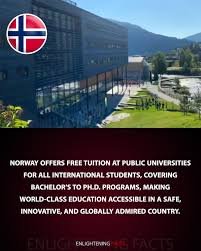
A new wave of international education opportunities is drawing global interest as Norway positions itself as one of the most attractive destinations for higher education in Europe. Recent announcements highlight multiple pathways for international students to pursue undergraduate, master’s, and doctoral programs in Norway for the 2026 to 2027 academic year, including scholarship opportunities that may not require IELTS. The development has sparked strong interest among students from developing regions who seek high quality education without the heavy financial barriers often associated with studying abroad. (Youth Diplomacy Forum)
Norway’s reputation for world class universities, strong research culture, and a safe, technologically advanced society has long made it a preferred destination for international students. What makes the latest opportunity notable is its accessibility. Many programs allow applicants to demonstrate English proficiency through alternative means such as prior education in English or institutional language assessments. Combined with scholarship funding that may cover tuition, housing, travel, and living costs, these initiatives are expanding access to global education for talented students across continents. (Youth Diplomacy Forum)
Norway’s Education Model: High Quality, Research Driven, and Globally Accessible
Norway’s higher education system is widely respected for its emphasis on research, innovation, and practical learning. Universities prioritize independent thinking, collaboration, and real world problem solving. Students often work closely with professors in small learning environments, which encourages strong academic engagement and career development.
Public universities in Norway operate under the oversight of the Ministry of Education and Research and are known for maintaining rigorous academic standards. Institutions such as the University of Oslo, the Norwegian University of Science and Technology, and the University of Bergen attract students from across the globe due to their strong academic programs and international research collaborations. (Wikipedia)
Another factor that strengthens Norway’s appeal is the broad availability of English taught programs. Many master’s and doctoral degrees are offered entirely in English, enabling international students to integrate into the academic environment without needing fluency in Norwegian. This policy has significantly expanded access for students from Asia, Africa, and Latin America.
Equally important is Norway’s academic philosophy. Universities place a strong focus on critical thinking and interdisciplinary learning rather than rote memorization. Students are encouraged to explore global issues such as climate change, sustainability, digital innovation, and public health through collaborative research projects. As a result, graduates often develop skills that are highly valued in international labor markets.
The country also offers a supportive learning environment. Modern campuses, digital infrastructure, and student welfare organizations ensure that learners have access to healthcare, housing support, sports facilities, and counseling services. These services are funded partly through student welfare organizations that operate across universities to enhance student well being and campus life. (Wikipedia)
Scholarships and Study Pathways Expanding Global Access
The 2026 to 2027 academic cycle includes several scholarship pathways connected to universities, international partnerships, and global academic initiatives. These programs are designed to reduce financial barriers and promote educational mobility for talented students from around the world.
Typical scholarship benefits may include:
- Full tuition coverage at participating institutions
- Monthly stipends to support living expenses
- Student accommodation or housing support
- Travel allowances for international students
- Health insurance coverage during study
- Research grants for postgraduate candidates
These funding packages can make it possible for students from low and middle income countries to pursue advanced degrees in Europe without taking on significant debt. The scholarships are often open to applicants pursuing bachelor’s, master’s, or PhD programs in fields such as engineering, information technology, environmental science, education, and development studies. (Youth Diplomacy Forum)
In many cases, applicants can demonstrate English proficiency through alternatives to IELTS. Universities may accept proof that the applicant previously studied in English, provide institutional language assessments, or conduct interviews to verify communication skills. This flexibility is particularly valuable for students who do not have access to standardized testing centers in their home countries.
At the same time, academic merit remains central to the selection process. Most scholarship programs evaluate candidates based on strong academic records, clear career goals, and evidence of leadership or community impact. Applicants who demonstrate a commitment to addressing global challenges often stand out during the selection process.
Living and Studying in Norway: What International Students Should Expect
Although Norway offers exceptional educational opportunities, students must also understand the practical aspects of living and studying in the country. The cost of living in Norway is relatively high compared to many other European destinations. However, scholarships and part time work opportunities can help offset these expenses.
International students typically need to budget for housing, food, transport, and personal expenses. According to official estimates, the average student living cost is about NOK 13,790 per month, which equals roughly NOK 166,859 per year. These funds cover accommodation, food, electricity, transportation, and daily living expenses. (studyinnorway.no)
Students from outside the European Economic Area must also demonstrate proof of financial support when applying for a study permit. This requirement ensures that international students can sustain themselves while pursuing their education.
One advantage is that student visas allow part time employment. International students may work up to 20 hours per week during academic semesters and full time during holidays. This opportunity enables students to gain professional experience while supporting their living costs.
Beyond academics, Norway provides a high quality of life. Cities such as Oslo, Bergen, and Trondheim are known for their clean environments, modern infrastructure, and strong public safety. Students often enjoy outdoor activities such as hiking, skiing, and exploring fjords, which contribute to a balanced lifestyle and mental well being.
Key Facts for International Students in Norway
| Category | Details |
|---|---|
| Average student living cost | About NOK 13,790 per month |
| Annual estimated expenses | Around NOK 166,859 |
| Work rights during study | Up to 20 hours per week |
| Main language of many graduate programs | English |
| Semester welfare fee | Approximately NOK 1000 |
| Student support services | Housing, healthcare, sports, counseling |
These factors collectively make Norway an appealing destination for international students seeking high quality education combined with strong social support systems.
Why Norway’s Opportunity Matters for Global Talent
The expansion of accessible study opportunities in Norway reflects a broader trend in international education. Countries are increasingly competing to attract global talent, recognizing that diverse student populations strengthen research, innovation, and economic growth.
Norway has positioned itself strategically in this global competition. By combining academic excellence with accessible scholarship pathways, the country is opening doors for students who might otherwise struggle to access international education.
The benefits extend beyond individual students. International graduates often build global professional networks, contribute to research innovation, and bring new ideas back to their home countries. In fields such as climate science, technology, and sustainable development, these exchanges can accelerate progress on pressing global challenges.
For students considering study abroad, the 2026 to 2027 academic cycle represents a significant opportunity. Norway’s universities offer rigorous academic training, modern facilities, and exposure to one of the most advanced societies in the world. With flexible language requirements and strong scholarship support, the pathway to studying in Norway is becoming more accessible than ever.
Trending FAQ
What degrees can international students study in Norway without IELTS?
International students may pursue bachelor’s, master’s, and doctoral programs depending on the university. Many institutions accept alternative proof of English proficiency, such as prior education in English or institutional language tests. (Youth Diplomacy Forum)
Are scholarships in Norway fully funded for international students?
Some scholarship programs provide full financial support including tuition coverage, accommodation assistance, and monthly stipends. Funding sources vary by university and international partnership programs. (Youth Diplomacy Forum)
Is education free in Norway for international students?
Public universities traditionally offered tuition free education, although policies have evolved and some programs now charge fees for non EU students. Scholarships and funding schemes can still significantly reduce the financial burden. (European Education Area)
Can students work while studying in Norway?
Yes. International students with a valid study permit are typically allowed to work up to 20 hours per week during the academic semester and full time during holiday periods. (studyinnorway.no)
Why do many students choose Norway for higher education?
Students are attracted by Norway’s strong research universities, safe society, English taught programs, and emphasis on innovation, sustainability, and critical thinking in education. (Youth Diplomacy Forum)