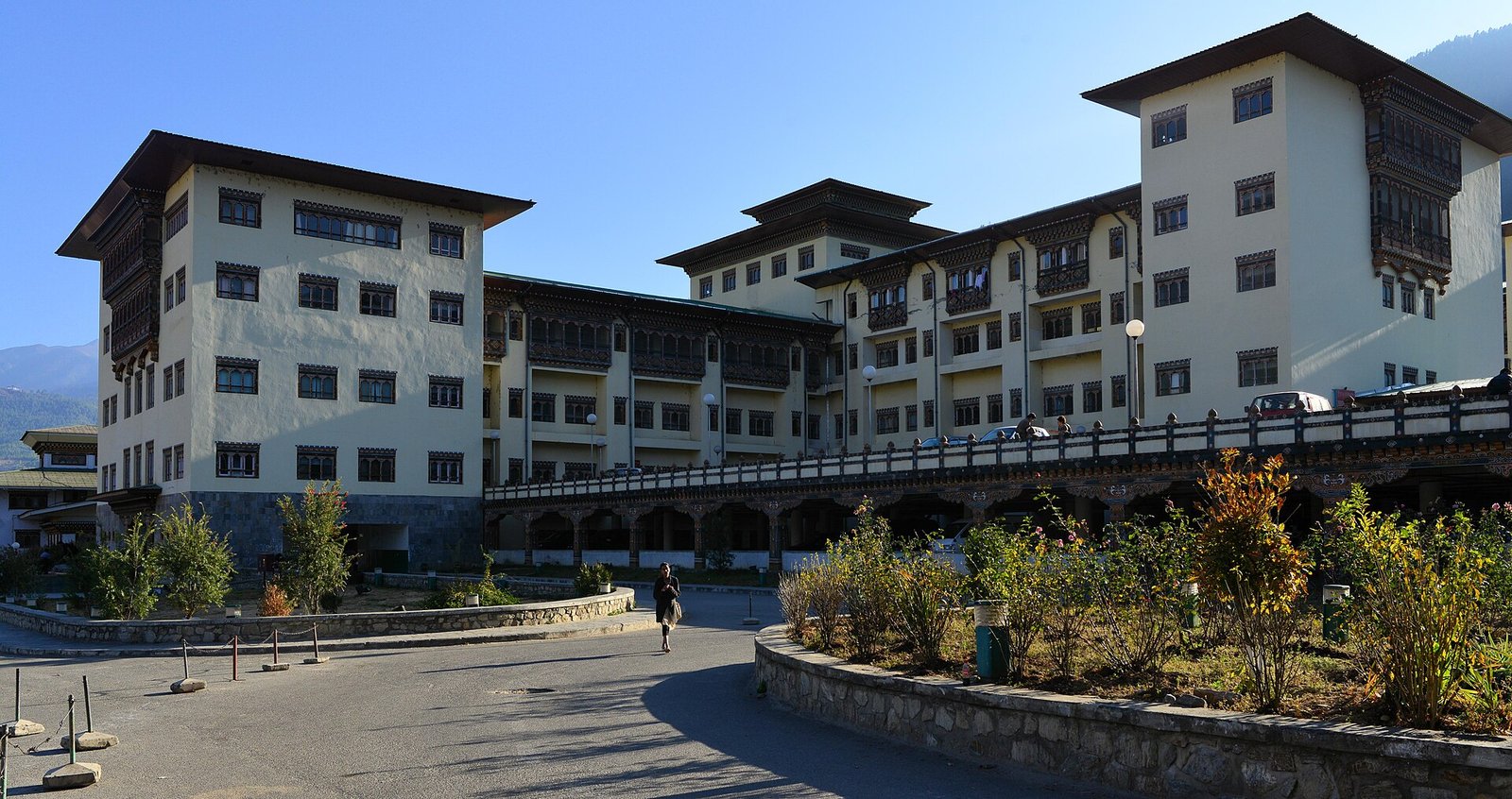
File photo: “Main building, JDWNRH Hospital, Thimphu”, Christopher J. Fynn / Wikimedia Commons. License: CC BY-SA 4.0.
A low-cost health plan can leave you exposed if a hospital will not accept it, you have to pay the bill upfront, or the insurer later refuses your claim. Before you choose cover for a course in Bhutan, find out what your university and immigration authorities require, which nearby facilities can treat you, and how the insurer handles claims from Bhutan. Those details matter whether you are coming alone or bringing a spouse or children.
Bhutan’s health services and insurance arrangements may work differently from what you are used to. Access, charges, referral options and visa paperwork can depend on your circumstances, so do not assume that a plan suitable for a short visit will meet your needs for a multi-year degree. Parents paying the costs should compare the full amount a student might have to pay, not just the premium. This guide gives you a practical way to check the rules, compare cover and prepare for care before you travel.
Start with your university and visa rules
Do not assume that health insurance is a universal requirement for every student visa, or that a policy accepted by one university will satisfy another. Requirements can depend on your course, visa category, the current immigration process and the university’s own enrolment conditions. Ask what is needed at admission, when the visa is issued, and during any later immigration or registration steps. Get the answer in writing.
Bhutan’s Royal University of Bhutan has constituent colleges in different locations, and the Royal Thimphu College is a separate institution in the capital. Their enrolment and student support arrangements are not necessarily identical. Ask the international office at the institution where you will study whether insurance is required, recommended, offered or checked as part of registration. Do not treat a general answer from another student as confirmation of your own obligations.
Ask five exact questions before paying:
- Is health insurance mandatory for admission, the student visa, immigration registration, or more than one of these?
- Will you accept a policy from an overseas insurer, or must the cover be arranged locally?
- Are there minimum benefits, dates of cover, or certificate-language requirements?
- Does the university provide or approve a plan, and which facilities can use it for direct billing?
- Can my spouse and children join the plan, and do they need separate immigration or insurance documents?
Keep the written answers, your policy certificate, full policy wording, payment receipts and any university or immigration instructions together. If your course lasts longer than a year, ask how early to renew, whether you need uninterrupted cover, and what proof to submit for each new academic or immigration period. Rules and procedures can change, so confirm them with the university’s international office and the relevant Bhutanese embassy or immigration authority before you travel.
Understand how healthcare works in Bhutan
Bhutan has a public health system, including hospitals and health centres, and private clinics and diagnostic services are also available in some places. Public healthcare is central to the country’s health services, but do not assume that a foreign student will receive every service free of charge. Eligibility and charges may differ by service and patient status. Ask the university and the facility directly what applies to international students.
Thimphu has the country’s national referral hospital, Jigme Dorji Wangchuck National Referral Hospital, as well as clinics and other services. Students in places such as Phuntsholing, Paro, Gelephu or Kanglung may have different choices and travel times. More specialised treatment may require referral to a larger centre. Facilities and access vary, especially outside the main urban areas, so check what is available near your actual campus and accommodation rather than relying on a general description of healthcare in Bhutan.
Whether you use public or private care, ask about payment before treatment when it is safe to do so. Some providers may require payment at the time of care, and an insurer may reimburse you later rather than pay the facility directly. This can mean you need enough available funds for a deposit or bill, even if the treatment is covered. Ask the insurer for its current list of direct-billing facilities and confirm the arrangement with the facility itself.
The World Health Organization and official travel-health sources can help you understand general health and travel considerations, but they cannot confirm your policy’s terms or the service a particular clinic will provide. Insurance cannot replace medical advice. Before choosing a plan, call two clinics and a hospital near your home to ask whether they accept it, bill the insurer directly, and can support you in a language you understand.
What should a student health plan cover?
Compare the exact benefits and limits, not just the policy’s headline description. Check whether treatment needs a referral or pre-approval, whether limits apply per visit or per year, and whether the insurer pays the provider or reimburses you.
| Type of care | What to check in the plan |
|---|---|
| Emergency care | Which emergencies are covered, what counts as an emergency, and whether you or someone with you must contact the assistance service promptly. |
| Hospital care | Inpatient limits, room and treatment charges, pre-approval rules, referrals, and whether the facility can bill the insurer directly. |
| Outpatient care | Limits for doctor visits, tests and specialist care, whether a referral is needed, and whether you pay first and claim later. |
| Prescription medicines | Whether prescribed medicines are covered, any limits or exclusions, and what receipts or prescriptions you must keep. |
| Medical evacuation | What medical need triggers evacuation, who decides it, where you could be taken, and whether transport and medical staff are included. |
| Repatriation | Whether the policy covers transport home after serious illness or death, and who authorises and arranges it. |
| Mental health | Cover for consultations, therapy, prescribed treatment, crisis support, referral requirements and limits. |
| Dental and vision | Whether routine checks, glasses, urgent dental treatment and dental emergencies are included or excluded. |
| Pregnancy and childbirth | Waiting periods, antenatal care, delivery, complications, newborn cover and any limits or exclusions. |
When money is tight, prioritise substantial hospital and emergency cover, practical access to care, and protection against a costly transfer for treatment that cannot be provided nearby. A plan with modest routine-care benefits may still be useful if you can budget for ordinary visits, but only if its major exclusions and payment rules are manageable for you.
Local insurance or international cover?
Students may be offered a university arrangement, find local voluntary cover, buy an international student or expatriate policy, or combine local cover with a separate travel policy. Availability and suitability vary. Do not rely on a travel policy as a substitute for long-term health cover unless its wording and the relevant authorities clearly support that use.
| Plan approach | Potential advantages | Questions or limitations to check |
|---|---|---|
| Local voluntary or student cover | May be familiar to the university or local providers and may suit care within Bhutan. | Is it actually available to foreign students? What facilities and treatments are included? Are limits, exclusions or referral rules suitable for your needs? |
| International student or expatriate insurance | May provide broader benefits, assistance services or cover for more than one country. | Does it cover a long stay in Bhutan and routine care there? Are local facilities in its network? Must you pay upfront, and how are claims settled? |
| A local plan plus separate travel cover | Could address routine local needs and separate travel periods or emergencies, if the policies work together. | Do the policies overlap or leave gaps? Which insurer pays first? Are travel days, trips home, evacuation and pre-existing conditions covered? |
Before buying, give the insurer your destination, study dates, campus location and any planned travel. Ask it to confirm in writing that the policy covers your situation, then check the university’s acceptance requirements and call a nearby provider to verify direct billing. Treat any insurer or product name suggested by another student as something to investigate, not as an endorsement.
Buying cover for a spouse or children
Family cover is not automatically comprehensive. Check the benefits for each person separately, including waiting periods and any age-related conditions. Make sure you know how the plan treats a new baby and whether cover must be added within a specified period after birth.
- For children, check paediatric visits, treatment for fevers outside normal clinic hours, vaccinations and urgent dental care. Confirm which facilities can see children and whether routine childhood care is covered.
- For pregnancy, ask about antenatal visits, childbirth, complications and waiting periods. A policy may exclude maternity or cover only some stages of care.
- Ask when a newborn becomes eligible, how to enrol the baby, and whether there is a deadline or separate premium.
- Confirm that every family member is named on the certificate and that the dates of cover include the whole stay.
- Remember that health insurance does not grant permission to live in Bhutan. Each family member’s visa or immigration status is a separate matter to confirm with the university and immigration authority.
Compare the full cost, not just the premium
The premium is the amount you pay to buy cover. An excess or deductible is the amount you must pay towards covered treatment before the insurer contributes, while a co-payment is your share of a covered bill. Annual limits cap what the insurer pays, and uncovered visits or exclusions remain your responsibility. Ask whether limits apply to each person, each type of treatment or the whole family.
The following is a made-up example using illustrative units, not a quote from an insurer in Bhutan. It shows how the plan with the lower premium can cost more overall if you need care.
| Cost item | Plan A | Plan B |
|---|---|---|
| Premium | 100 units | 180 units |
| Excess paid during the year | 200 units | 50 units |
| Co-payments and uncovered visits | 150 units | 60 units |
| Illustrative total paid | 450 units | 290 units |
Make your own comparison using realistic treatment scenarios, such as a doctor visit, prescribed medicine and a hospital admission. Bhutan’s currency is the ngultrum (BTN). If you pay premiums or claims in another currency, ask your bank and insurer how exchange rates, conversion fees and payment timing could affect the amount you receive or owe.
Read exclusions before you sign
Answer every medical-history question accurately. A pre-existing condition may be excluded, covered only after a waiting period, or handled under a special limit. Do not assume that a condition is covered because you disclosed it; ask the insurer to confirm the decision and any terms in writing.
Check whether you can use care outside the insurer’s network and whether reimbursement is limited to an amount the insurer considers reasonable. If you plan fieldwork, outdoor activities or sports, ask whether those activities are excluded or need extra cover. Students on clinical placements should check whether the university, placement provider or policy covers illness, injury and any required professional activity. Do not assume student cover includes work or placement risks.
Read how the insurer defines medical evacuation. It may require a doctor to confirm that necessary treatment is unavailable locally, and the insurer may choose the destination and transport provider. Confirm whether evacuation and repatriation have separate limits. For planned hospital admissions, ask when pre-authorisation is required and how to contact the insurer if a referral or emergency admission happens outside office hours.
What to do before you leave
Arrange a check-up with a health professional before departure and ask about vaccinations and any ongoing treatment relevant to your circumstances. Check official travel-health guidance for Bhutan, then ask a qualified professional what is appropriate for you. If you take prescription medicines, confirm with the Bhutanese embassy or relevant authority whether your medicine may be brought into the country and what documents or quantity limits apply. Do not rely on a general answer from a travel forum.
Use this checklist before departure:
- Get a certificate showing the full name of every insured person and the correct dates of cover.
- Save the complete policy wording, benefit schedule and claims instructions, not only the membership card.
- Store the insurer’s 24-hour assistance number and confirm how to call it from Bhutan.
- Identify a hospital, clinic and pharmacy near your home, and check payment and direct-billing arrangements.
- Carry prescribed medicines in their original packaging, with supporting prescriptions or a doctor’s letter where appropriate.
- Confirm that cover includes your travel days, any trips home and any travel outside Bhutan you plan to make.
- Keep offline copies of your policy, passport details, prescriptions and emergency contacts in a secure place.
What to do after arriving in Bhutan
During your first week, check that the policy is active, your details are correct and the university has any documents it requested. Keep your enrolment and immigration records with your insurance papers. Ask the university where students should seek care after hours and which local facilities have current arrangements with your insurer.
Save local emergency contacts once you arrive, and confirm the correct emergency numbers with your university or accommodation provider. Do not rely on a number copied from an old webpage or another traveller. Keep the insurer’s assistance contact separate from local emergency contacts, since they serve different purposes.
For a claim, follow the policy’s notification rules, ask the provider for an itemised bill, and keep prescriptions, referrals, proof of payment and medical records. Send the documents in the format and timeframe the insurer requires, and retain copies. If a claim is refused, request the reason and the policy clause in writing, check whether missing documents or an appeal deadline are involved, and follow the insurer’s complaint process. Ask your university’s international office for practical guidance if you are unsure where to turn.
Common questions from international students
Is the cheapest local plan enough?
Not necessarily. First confirm that the plan is available to you and accepted for your university or immigration process, then compare its hospital limits, exclusions, payment arrangements and access to care near your campus. A low premium may leave you paying much more for treatment or transport.
Can a travel plan cover a multi-year degree in Bhutan?
Do not assume so. Travel policies may have limits on trip length, routine treatment, renewals or residence abroad. Ask the insurer to confirm in writing that your policy covers the full course period and meets any requirements set by your university or immigration authorities.
Does a family plan always cover maternity and dental care?
No. Maternity may have waiting periods or exclusions, while dental cover may apply only to emergencies or be limited. Check pregnancy, childbirth, newborn enrolment and dental benefits for each family member before you pay.
What happens if I move to another city in Bhutan?
Your policy may remain valid, but the nearest suitable facility and direct-billing options can change. Before moving, ask the insurer which providers are available near your new home and whether you need a new referral or updated contact details.
Pro Tips
Choose cover that meets your university’s requirements and can be used at a clinic or hospital you can realistically reach. Confirm direct billing with the provider, not only the insurer.
Before paying, check every insured person, the full dates, the total limits and the costs you may pay yourself. Keep enough accessible funds for an upfront bill if reimbursement is required.
For reliable answers, start with your university’s international office, the Bhutanese embassy responsible for your application, and the relevant immigration authority. Use official public-health and travel sources for general guidance, then confirm policy details directly with the insurer.
References
- World Health Organization. (n.d.). Bhutan. https://www.who.int/countries/btn/
- Centers for Disease Control and Prevention. (n.d.). Travelers’ health. https://www.cdc.gov/
- Australian Government, Smartraveller. (n.d.). Travel advice. https://www.smartraveller.gov.au/
- UK Government. (n.d.). Foreign travel advice. https://www.gov.uk/
- U.S. Department of State. (n.d.). Travel information. https://travel.state.gov/
- Royal Government of Bhutan, Department of Immigration. (n.d.). Official website. https://www.doi.gov.bt/
- Royal University of Bhutan. (n.d.). Official website. https://www.rub.edu.bt/
- Royal Thimphu College. (n.d.). Official website. https://www.rtc.bt/